
New paper in Genes, Brain and Behavior
Congratulations to Carl Litif, first author, and all co-authors on our new paper, “Reln Haploinsufficiency Enhances Fentanyl-Induced Locomotion and Dorsal Striatal Activity Without Affecting Opioid Reinforcement and Relapse-Like Behavior,” published in Genes, Brain and Behavior.
We found that Reln haploinsufficient mice show enhanced fentanyl-induced locomotion and dorsal striatal Fos activity. Opioid self-administration, extinction, and cue-induced seeking were unchanged. This suggests Reelin modulates opioid-responsive circuits rather than the learning processes behind opioid reinforcement.
Read the paper here: https://onlinelibrary.wiley.com/doi/10.1111/gbb.70072
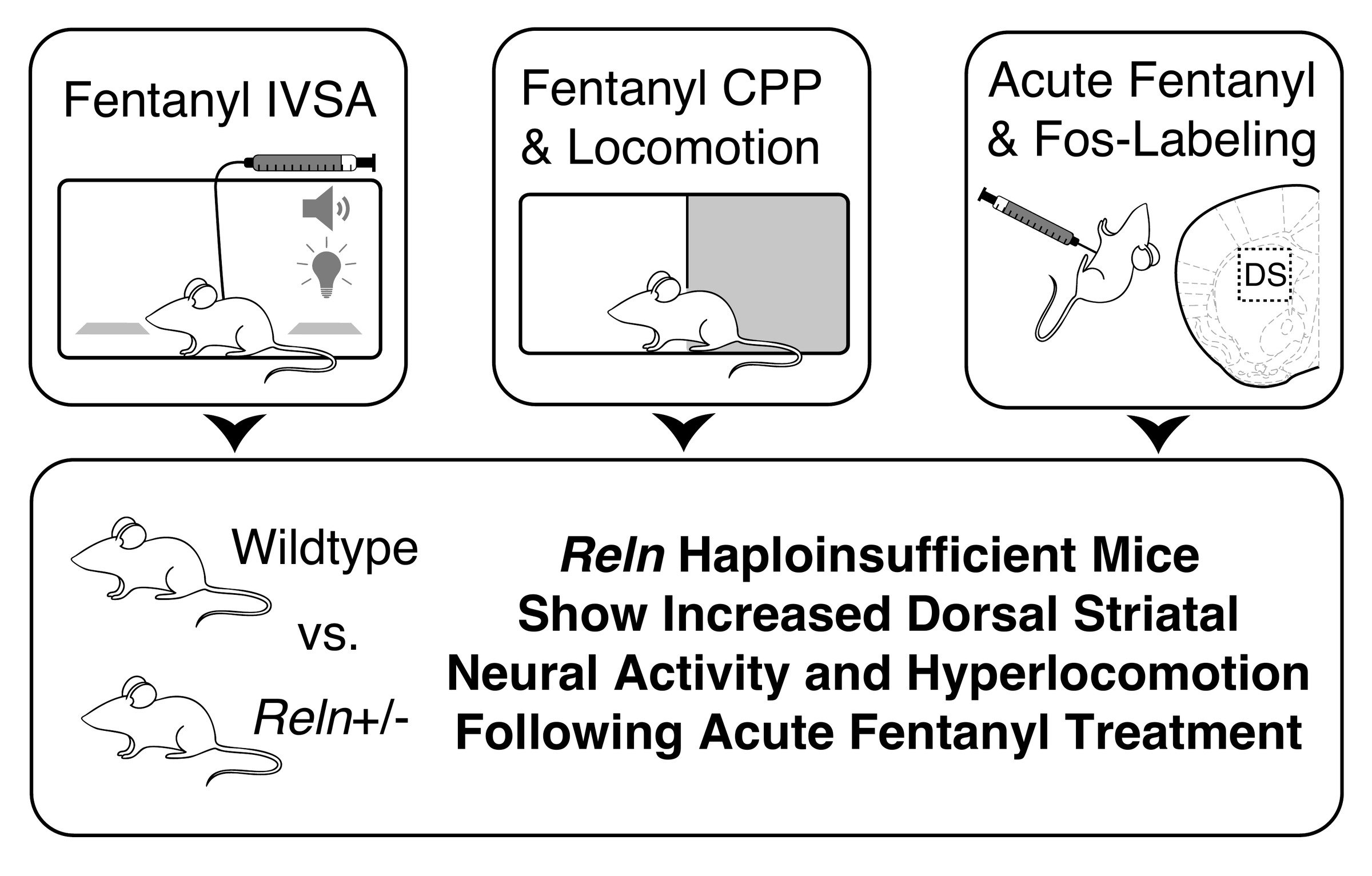
Reln haploinsufficiency does not alter fentanyl self-administration, relapse-like seeking, or conditioned place preference in mice. Instead, reduced Reln expression selectively enhances acute fentanyl-induced locomotion and dorsal striatal Fos activation, positioning Reelin as a modulator of opioid-evoked neuronal activity rather than opioid reinforcement.